
Cards Against Humanity is a fill-in-the-blank party game built around dark, satirical humour, and it has a devoted following at New Zealand game nights, flats and parties. If you shop for it in Aotearoa you will almost always find the Australian Edition — a version rewritten for Australian and New Zealand players — rather than the original American set. This Cards Against Humanity NZ guide covers what is in the box, how a round actually plays out, the editions sold here, the free print-at-home option, the optional house rules, and sensible ways to manage the game’s deliberately offensive content. Everything below reflects how the game is sold and licensed as of late 2026. For hosting tips, custom cards and house rules for a game night, see our main Cards Against Humanity guide.
Quick Facts
| Publisher | Cards Against Humanity, LLC |
| Type | Fill-in-the-blank party card game |
| Players | 3 or more (best with about 5–8) |
| Age rating | 17+ (Family Edition 8+) |
| Cards (Australian / main set) | 600 total — 500 white, 100 black |
| Play time | About 30–90 minutes |
| Typical NZ price (base set) | Around NZ$48–$70 |
| Free version | Official print-at-home PDF (Creative Commons, personal use) |
What the game is and how a round works
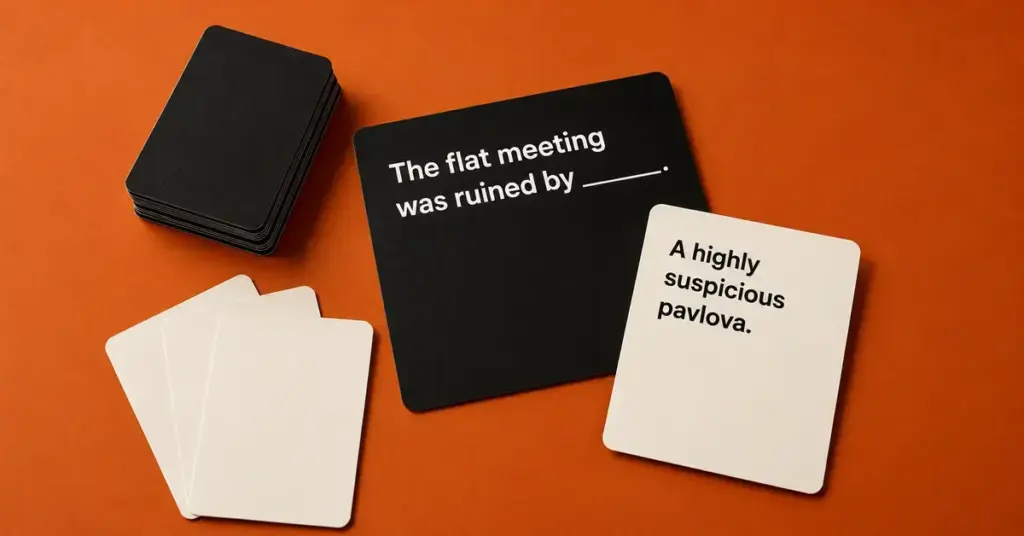
The game is designed for three or more players and tends to work best with roughly five to eight people around a table. Each player holds a hand of 10 white cards, which contain words or phrases. One player each round acts as the judge — the official rules call this person the Card Czar — and reads a prompt from a black card, which is either a question or a sentence with a blank to fill in. Everyone else plays a white card (or two, when the black card says to) to answer the prompt as cleverly, absurdly or outrageously as they can.
The Card Czar shuffles the submitted cards so nobody knows who played what, reads them all aloud, and picks a favourite. The player who submitted the winning card keeps that black card as a point — the rules call these “Awesome Points.” Everyone draws back up to 10 cards, the role of Card Czar passes to the next person, and play continues. The game ends whenever the group decides, or when a player reaches an agreed number of points.
One round, step by step
- Deal: Each player starts with a hand of 10 white cards.
- Prompt: The Card Czar draws one black card and reads it to the group.
- Answer: Everyone else passes one white card face down (two if the black card is a “Pick 2”).
- Judge: The Card Czar shuffles and reads the answers, then chooses the one they like best.
- Score: The winning player keeps the black card as a point, hands are refilled to 10, and the Card Czar role moves on.
What comes in the box
The Australian Edition is the standard base game in New Zealand. It is a complete, standalone set — you do not need anything else to play. The current version contains 600 cards in total: 500 white answer cards and 100 black prompt cards. The updated (version 2.0) printing added more than 150 new cards compared with the first release, trading out dated references for fresher ones. It is rated for ages 17 and up because the content is explicit and often confronting.
Because the humour leans so heavily on cultural references, the Australian Edition swaps out obscure American names and politics for material that lands better with Kiwi and Australian players. The table below sets out the main editions and how they differ.
| Edition | Who it is for | Cards | Notes |
|---|---|---|---|
| Australian Edition (main game) | Adults, 17+ | 600 (500 white / 100 black) | Standalone base game, localised for AU/NZ |
| Family Edition | Everyone, 8+ | 600 | Standalone; absurd and gross-out humour, no adult themes |
| Expansion boxes | Owners of a base set | ~300 each (historically) | Shuffle extra cards into a base game; not standalone |
| Small themed packs | Owners of a base set | ~30 each | Topic-specific mini packs |
| Free print-at-home PDF | DIY players | Full set | Official download, Creative Commons licensed for personal use |
Where to buy it in New Zealand
Cards Against Humanity’s own webstore does not ship to New Zealand — the site marks its products “Unavailable In Your Region” for local shoppers — so most people buy through New Zealand retailers or import a copy. Electronics and entertainment chains such as JB Hi-Fi and Harvey Norman stock the Australian Edition both in store and online, and general toy and game shops often carry it around the holidays. Second-hand copies and older expansions regularly turn up on Trade Me, which is worth checking if you want a cheaper set or a pack that has gone out of print.
Prices move with sales, so treat the figures below as a guide rather than a fixed rate. Expect roughly NZ$48 to NZ$70 for a base set at the main retailers.
Where to Buy
| Retailer | Edition | Approx. price (NZD) |
|---|---|---|
| JB Hi-Fi NZ | Australian Edition | ~$59.99 (often on sale from ~$47.99) |
| Harvey Norman NZ | Australian Edition V2 | ~$69.99 |
| JB Hi-Fi NZ | Family Edition | ~$59.99 |
| Official webstore | Main game & expansions | Not shipped to NZ (“Unavailable In Your Region”) |
| Print at home | Free official PDF | Free |
The free print-at-home version
One genuinely unusual thing about this game is that the publisher gives it away. Since launch, the full base game has been available as a free PDF on the official website, released under a Creative Commons licence (Attribution–NonCommercial–ShareAlike). In practice that means you can legally download the files, print the cards, cut them out and play at no cost — you just cannot sell copies or use them to make money. The company updates and rewrites the set roughly once a year, so the free files are kept reasonably current.
The trade-off is obvious: printing and cutting hundreds of cards takes time, and home-printed cards are flimsier than the professionally produced box. The free version is a good way to try the game before buying, to replace cards you have lost, or to play when a shop-bought copy is not available. Only download from the official site; the many “printable Cards Against Humanity” pages scattered around the web are unofficial and often unsafe.
Expansions and extra packs

Once a group knows the base game well, expansions keep the prompts and answers feeling new. Historically the publisher sold large colour-coded boxes — Red, Blue and Green — that each added around 300 cards, alongside dozens of smaller themed packs covering topics like science, pop culture and specific decades. The current line-up is streamlined into fewer boxes (such as the Everything Box and the Hot Box) plus small packs, and the exact range changes over time. In New Zealand, availability depends on what local retailers and importers have in stock, so a pack listed overseas is not guaranteed to be on a shelf here.
- Large expansion boxes: add a few hundred cards at once; need a base set to use.
- Small themed packs: short, topic-specific sets of around 30 cards.
- Family Edition expansions: such as the Glow in the Dark Box, designed to extend the child-friendly set.
- Mixing decks: shuffling several expansions into one base game creates a very large pool of cards, so repeats become rare.
Optional house rules
The printed rulebook treats its own rules as suggestions and openly encourages groups to change them. Several optional rules are printed right in the official instructions, and others have grown up around the game. These change the pace and the strategy without needing anything extra.
- Rando Cardrissian: deal one extra hand to an imaginary player and play a random card from it each round. If “Rando” wins the game, the official rules say everyone else should go home in shame.
- Rebooting the Universe: at any time, trade in a point to discard your whole hand and draw 10 new cards.
- Packing Heat: for “Pick 2” prompts, everyone draws an extra card first so there are more options.
- God Is Dead: play with no Card Czar and let the whole group vote on the best answer each round.
- Never Have I Ever: if a card confuses you, you may reveal it and swap it for a new one — at the cost of admitting you did not get the joke.
Some groups also attach drinking rules, such as a sip for anyone whose card is not chosen. These are entirely unofficial. If your group plays that way, keep it optional, make sure everyone is of legal drinking age and comfortable, and never pressure anyone to drink. The game is just as fun without alcohol. For alcohol-free alternatives that suit the same crowd, Exploding Kittens and Scattergories both play well with a group.
Playing with mixed ages and managing the content

By design, the adult game is built to be offensive, so it is not something to pull out in front of children or colleagues without thought. If you want the same style of play for a younger or mixed-age group, the Family Edition is the right choice: it is a separate, standalone set recommended for ages eight and up that keeps the fill-in-the-blank format but swaps mature themes for absurd, gross-out humour. It is a popular gift and a gentler entry point, and it fits alongside other kids’ card games for family evenings.
Even among adults, it helps to set expectations before you start. A widely used safeguard is a “no questions asked” policy: any player can remove a card or skip a prompt that genuinely upsets them, without having to explain why. Playing with people who know each other’s sense of humour, and agreeing up front on what is off-limits, keeps the game in the realm of comedy rather than real discomfort.
A short history of the game
The name is a play on the legal phrase “crimes against humanity,” signalling the game’s deliberately transgressive tone. It was created by a group of eight friends who had attended the same high school in Highland Park, Illinois, near Chicago. They funded the first print run through a crowdfunding campaign that ran over the 2010–2011 new year: the project asked for US$4,000 and raised more than US$15,000, roughly four times its goal. The design was inspired by earlier matching and fill-in-the-blank games such as Apples to Apples and Mad Libs, and the game was briefly called “Cardenfreude” before its final name stuck.
From there it grew into one of the best-known modern party games, expanding through new editions, regional versions like the Australian Edition, and a long run of expansions and one-off stunts. If you are curious about how it fits into the wider story of card games, our overview of the world of card games puts titles like this in context, and it sits comfortably in New Zealand’s board game scene alongside other social favourites.
How it compares to other party card games
Cards Against Humanity is not the only group card game worth owning, and it is not for everyone. Its appeal is the comedy of pairing a prompt with an unexpected answer, which rewards quick wit and a shared sense of humour more than any real strategy. If the mature content does not suit your group, there are lighter options with the same social energy — the frantic card-matching of Uno Flip is a good example for all ages. Choosing between them comes down to who is playing: the adult set for like-minded friends, the Family Edition or a gentler game for wider gatherings.
Important note
Cards Against Humanity contains explicit, crude and intentionally offensive content and is sold for players aged 17 and over. The Family Edition is the version intended for children. Any drinking rules described here are unofficial; alcohol should only ever involve adults of legal drinking age (18+ in New Zealand) and should always be optional. This article is an informational guide, not a recommendation to buy any particular edition. Card counts, editions and prices change over time — always confirm the current details on the retailer or official page before purchasing.
Sources
- Cards Against Humanity — Australian Edition (official product page)
- Cards Against Humanity — official site and free downloads
- Cards Against Humanity — Family Edition (official product page)
- JB Hi-Fi NZ — Cards Against Humanity Australian Edition
- Harvey Norman NZ — Cards Against Humanity Australian Edition V2
Frequently Asked Questions
Which edition should New Zealanders buy?
For adults, the Australian Edition is the standard choice, because its cards are rewritten for Australian and New Zealand culture rather than American references. It is a complete, standalone base game, so you do not need anything else to start playing.
Is there really a free version?
Yes. The publisher offers the full base game as a free PDF on its official website under a Creative Commons licence for personal use. You can print and play it at no cost, but you cannot sell copies or use it commercially. Only download from the official site, not from random third-party pages.
Is Cards Against Humanity suitable for children?
The standard game is not; it is rated 17+ and contains explicit humour. For younger or mixed-age groups, the separate Family Edition is recommended for ages eight and up and replaces adult themes with absurd, gross-out jokes.
How many players do you need?
You need at least three players, and the game is generally at its best with around five to eight people. It can stretch to much larger groups, though very big games mean longer waits between turns as Card Czar.
Where can I buy it in New Zealand?
Retailers such as JB Hi-Fi and Harvey Norman stock the Australian Edition, and copies and expansions also appear second-hand on Trade Me. The publisher’s own webstore does not ship to New Zealand, so local retailers, importers or the free download are the practical options.