
“Warehouse games” is a label that covers more ground than most people expect. At its core it describes a family of logic puzzles in which you play a warehouse keeper pushing crates onto their correct storage spots — the genre defined by the Japanese classic Sokoban. The same phrase is often used more loosely for logistics-themed board games, supply-chain training simulations, and even “shedding” card games where the aim is to empty your hand. This guide sorts out what warehouse games really are, where the genre came from, how the signature push-only rule works, and how the warehouse idea shows up across digital apps, tabletop boxes and card games that New Zealand players can find today.
Key Points
- Genre root: the box-pushing puzzle Sokoban — Japanese for “warehouse keeper” — created by Hiroyuki Imabayashi in 1981.
- Core rule: push crates one at a time onto goal squares; you can never pull a crate.
- Main hazard: deadlocks, where a crate becomes permanently stuck and the level is unsolvable.
- Key skills: spatial reasoning, forward planning and working memory.
- Where to play: free and paid puzzle apps, the official The Sokoban on Nintendo Switch, physical sets, and shedding-style card games.
What “warehouse games” actually means
The term is used in three overlapping ways, and separating them makes everything that follows clearer.
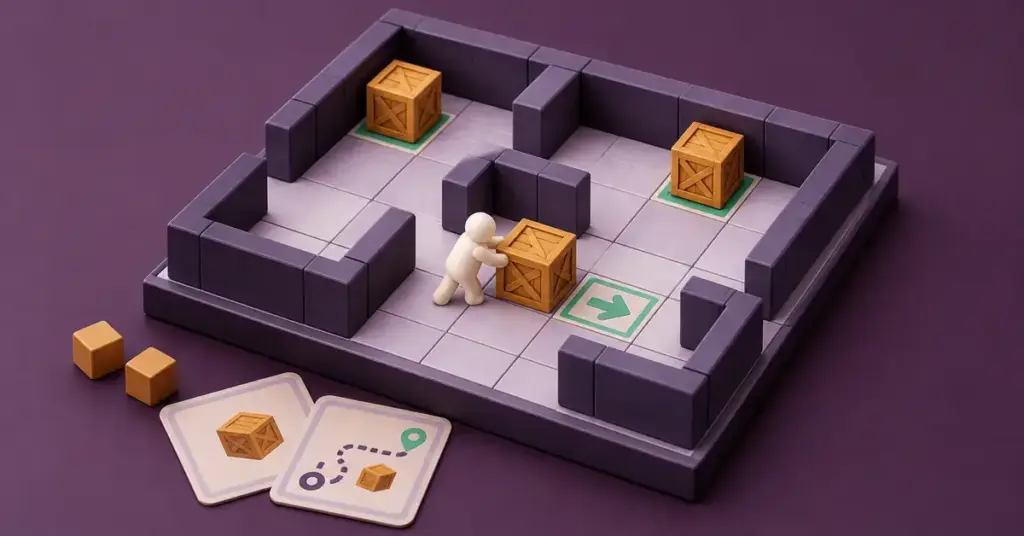
- The box-pushing puzzle. Used precisely, a warehouse game is a grid-based logic puzzle in the Sokoban tradition. You move a single worker around a storeroom and push crates one at a time until each crate sits on a marked goal square. This is the oldest and most literal meaning.
- A theme for logistics games. The phrase is also a loose theme label for board games and classroom simulations about receiving, storing and shipping goods — anything that puts you in charge of a stockroom, a factory or a supply chain.
- A metaphor for shedding card games. Some players stretch it further to cover card games where you “clear out” a hand, treating your cards like stock you have to ship before your opponents do.
It is worth noting what warehouse games are not. If you have arrived here looking to buy boxed games cheaply from a large retailer, that is a shopping question rather than a game genre — our guides to board game warehouse shopping in New Zealand and to The Warehouse puzzles cover that side of things. The rest of this article is about the games themselves.
Where the genre came from: the story of Sokoban
The warehouse-keeper puzzle was created by Japanese designer Hiroyuki Imabayashi, who built the first version as a hobby project in 1981 for the NEC PC-8001 home computer. It had text-based graphics and just five levels. The following year his company, Thinking Rabbit, released the first commercial edition for the NEC PC-8801 and other Japanese machines. The name is the key to the whole genre: Sokoban (倉庫番) translates literally as “warehouse keeper”.
From there the puzzle spread worldwide through dozens of ports and clones. Memorable versions include Boxxle on the Game Boy (1989), Shove It! …The Warehouse Game on the Sega Genesis (1990) and Super Sokoban on the Super Famicom (1993), while the official modern release, simply titled The Sokoban, arrived on Nintendo Switch and PlayStation 4 in 2021. According to figures reported by Japan’s Chukyo Television Broadcasting, the series had sold more than four million copies worldwide by 2018. Because the rules are so simple yet so demanding, the puzzle also became a favourite test case in computer science, which we return to below.
How a warehouse puzzle works
The rules fit in a sentence or two, which is a large part of the appeal. You control a single warehouse keeper on a grid of floor squares bounded by walls. The keeper moves one square at a time, up, down, left or right, onto any empty floor square. When the keeper walks into a crate, it pushes that crate into the empty square directly beyond it. The level is solved when every crate rests on a goal square. There is no timer and no dice — the whole challenge is working out the right order of pushes.
The push-only rule and why it matters
Two restrictions give the genre its bite. First, crates can only be pushed, never pulled, so once a crate is against a wall you can no longer get behind it from that side. Second, you can only push one crate at a time; a crate backed by a wall or by another crate simply will not move. Together these rules mean a single careless push can ruin a puzzle that otherwise looked easy. Strong players scan the room before touching anything, picturing how they will reach the far side of each crate, and they always leave themselves a route back out — an “escape path” — rather than walking into a dead end.
Spotting deadlocks before they happen
A deadlock is any position from which the puzzle can no longer be solved, even though play can technically continue. Learning to recognise them on sight is the single biggest step from beginner to confident solver. The common ones are:
- Corner deadlock: a crate pushed into a 90-degree corner that is not itself a goal square. It can never be moved again in either direction.
- Wall-line deadlock: a crate shoved flat against a long wall with no goal anywhere along that wall. It can slide left and right but never leave the wall.
- Frozen block: four crates packed into a 2×2 square. None of them can move because each blocks the others.
Warehouse and logistics ideas in card and board games
The box-pushing puzzle is only one branch of the warehouse family. The theme of taking goods in, storing them and getting them out again runs through plenty of tabletop and card games too, and the same mental habits carry over.
Shedding card games share the warehouse keeper’s central goal in reverse: instead of placing stock neatly, you are racing to clear your “stockroom” — your hand — before anyone else. Games such as Last Card, Uno Flip and Crazy Eights all reward the same tactical holding and timing: keeping a powerful card back to block an opponent who is about to go out, much as a dispatcher holds an order until the moment it pays off. These are their own genre within the wider world of card games, but the “empty it out efficiently” mindset is unmistakably warehouse-like.
Logistics simulations take the theme literally. The best-known is the Beer Distribution Game, developed at MIT Sloan and dating back to 1960, in which teams play the retailer, wholesaler, distributor and factory links of a supply chain and quickly discover how small ordering mistakes snowball into shortages and gluts. It is still used in universities and companies worldwide to teach systems thinking, and it is a genuine example of a warehouse-themed game rather than a marketing claim.
Comparison
| Format | Core goal | Signature mechanic | Best for |
|---|---|---|---|
| Classic box-pushing puzzle (Sokoban) | Push every crate onto a goal square | Push-only, one crate at a time | Solo logic solving |
| Digital puzzle app | Clear hundreds of ready-made levels | Undo button and level editors | Daily practice and travel |
| Logistics simulation (e.g. the Beer Game) | Run a supply chain without shortages or gluts | Team ordering and communication | Group learning and training |
| Shedding card game | Empty your hand before opponents | Matching, blocking and timing cards | Fast, social play |
Strategy: planning several moves ahead
Whatever the format, warehouse games reward patience and foresight over speed. The most common mistake is “short-termism” — making a move that looks good now but quietly ruins the board. A few habits travel well across the whole genre:
- Look before you push. Never move a crate until you know where it is going and that you can still reach the next one afterwards.
- Keep a lane open. Leaving a clear central corridor lets the keeper reach any part of the room, instead of trapping yourself behind your own crates.
- Order your goals. Fill the goal squares furthest from your working space first, so you are not forced to push crates back through finished areas.
- Use undo as a learning tool. On digital versions, stepping back to test an idea is how you build an intuition for which pushes are safe.
This “think forward, then act” discipline is the same one that underpins good play in almost any thinking game. If you enjoy mapping out consequences, our explainer on the game tree in strategic decision making and the broader guide to board game strategy dig into the same ideas in more depth.
What makes warehouse puzzles worth playing
Beyond entertainment, box-pushing puzzles are often praised for building spatial reasoning — the ability to picture how objects will interact before you move them — along with planning and patience. The deceptively simple rules also made the puzzle a serious object of study: researchers have shown that deciding whether a given Sokoban level is solvable is both NP-hard and PSPACE-complete, meaning there is no known shortcut that reliably cracks every large puzzle quickly. That mathematical depth is exactly why the game has been used for decades to test artificial-intelligence planning systems.
Skills these puzzles can build
- Deductive logic: tracing how one move closes off or opens up later options.
- Efficiency: searching for the solution that uses the fewest pushes or steps.
- Working memory: holding the current layout in mind while planning several moves ahead.
- Resilience: recognising a dead end early, resetting and trying a cleaner approach.
The gentle difficulty curve of early levels also makes these games approachable for children, and they sit comfortably alongside other logic-friendly options in our round-up of card games for kids in New Zealand.
Choosing a version: digital, physical or card

For most New Zealand players the realistic choices are a free or low-cost puzzle app, a physical set, or a card game with a related shedding theme — and they suit different situations.
Digital apps are the easiest entry point. App stores list a large number of free Sokoban-style puzzle games, and the official The Sokoban is available on Nintendo Switch. Their big advantages are an unlimited supply of levels and an undo button, which physical sets cannot offer — ideal for daily practice or travel. Stick to well-reviewed titles from reputable developers and check the permissions any free app requests.
Physical sets, including wooden box-pushing toys and logic-puzzle books, are better for younger players and for playing together at a table; just confirm that small pieces are safe for the age group. Card games with a shedding theme are the most portable of all and the easiest to learn in a few minutes. If you prefer to browse in person, local hobby shops and the specialist retailers covered in our guides to buying from a board games warehouse are good starting points.
Sources
FAQ
What is the origin of warehouse games?
The genre was defined by Sokoban, created by Hiroyuki Imabayashi in 1981 and first released commercially by his company Thinking Rabbit in 1982. The Japanese name means “warehouse keeper,” and the goal is to push crates onto storage squares.
Why is the push-only rule so important?
Because crates can only be pushed and never pulled, a single wrong move can leave a crate permanently stuck — for example in a corner that is not a goal. That constraint is what turns a simple grid into a genuine planning puzzle.
What is a deadlock in a warehouse puzzle?
A deadlock is a position from which the level can no longer be solved, such as a crate frozen in a corner, pinned against a wall with no goal, or locked in a 2×2 block. Spotting deadlocks early is the main skill expert solvers rely on.
How do warehouse card games differ from the box-pushing puzzle?
The classic puzzle is about spatial movement on a grid. Card games linked to the warehouse theme, such as shedding games, are instead about clearing your hand efficiently and timing which cards to play — the same “move stock out” idea expressed through cards rather than a grid.
Are these games suitable for children?
Yes. Early levels are simple enough for primary-school children and help build logic, patience and spatial reasoning, while later levels stay challenging for adults. For physical sets, just check that any small components are age-appropriate.